
Keyword Research in SEO: The Meaning (And Why Most Beginners Mess It Up)

If you’ve spent any time reading about SEO at all, you’ve probably seen the term “keyword research” more times than you can shake a stick at. It gets thrown around a lot, and honestly, that’s because it deserves the attention. It’s the foundation everything else in SEO gets built on.
Here’s the simplest way I can put it: before you write a single word of content, you need to know what your audience is actually typing into Google. Not what you think they’re searching for, not the industry jargon you use internally, but the real, sometimes clumsy, often surprising phrases people use when they’re looking for help.
That’s the whole job of keyword research.
So What Is Keyword Research, Really?
Keyword research, at its heart, is the process of determining what words and phrases people type into search engines when they are looking for information, trying to solve a problem, comparing options, or buying something.
Let’s say someone’s shopping for skincare. Depending on where they are in their decision process, they might search:
- skincare products online
- best skincare products
- skincare products for oily skin
- best face wash for oily skin
- affordable skincare products
Each of those is a slightly different door into the same room. Someone doing keyword research digs into which doors people are actually using, how often, and what they expect to find once they walk through.
Why It Matters More Than People Think
A lot of beginners treat keyword research as a box to check before writing a blog post. In reality, it shapes almost every decision you make afterward.
It reveals the gap between your language and your customer’s language. You might call it a “professional facial treatment.” Your customer is Googling “best facial near me.” If you never bridge that gap, you’re invisible to the person you’re trying to reach.
It tells you what to actually write about. Once you know people are searching “how to choose a face wash,” you have a topic with built-in demand. You’re not guessing anymore.
It uncovers content you hadn’t thought of. One seed keyword almost always branches into a dozen more specific angles. Start with “skincare products” and you’ll find your way to beginner routines, oily-skin routines, dry-skin concerns, and more — each one a potential page or post.
It gives structure to your whole site. Different keywords naturally belong on different types of pages: your homepage, service pages, product pages, category pages, blog posts, FAQs. Keyword research helps you map that out instead of building your site structure on instinct alone.
The Different Flavors of Keywords
Not all keywords behave the same way, and it helps to know the categories.
Short-tail keywords are broad — one or two words, like “SEO,” “skincare,” or “laptops.” They tend to pull huge search volume and equally huge competition, which makes them brutal to rank for if you’re just starting out.
Long tail keywords are longer, more specific phrases like “best skincare products for oily skin” or “how to start keyword research for SEO”. They get less traffic individually, but they’re far easier to rank for and usually convert better because the searcher knows exactly what they want.
Branded keywords include a specific brand name — “Nike shoes,” “Apple iPhone,” “Canva.” These usually matter most to the brand itself or to competitors targeting comparison searches.
Non-branded keywords skip the brand name entirely — “best running shoes,” “skincare products online.” This is where most organic opportunity for growing sites tends to live.
Search Intent: The Part People Skip (And Shouldn’t)
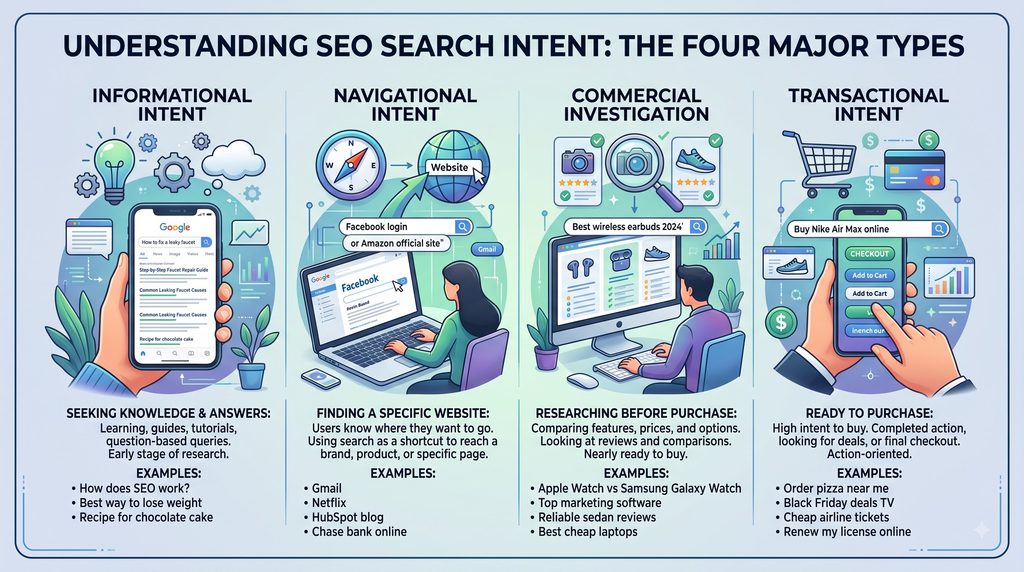
If there’s one concept that separates decent keyword research from great keyword research, it’s understanding why someone is searching a particular phrase — not just what they’re typing.
Someone searching “what is keyword research” wants an explanation. Someone searching “best keyword research tools” is comparing products. Someone typing “buy skincare products online” already has their credit card out. Same general topic, three completely different mindsets — and three completely different types of content needed to satisfy them.
Search intent generally breaks down into four buckets:
- Informational — the searcher wants to learn something (“what is on-page SEO?”)
- Navigational — they’re trying to reach a specific site or page (“YouTube,” “Amazon login”)
- Commercial investigation — they’re comparing options before deciding (“best SEO tools,” “WordPress vs Shopify”)
- Transactional — they’re ready to act, usually to buy (“buy sunscreen online”)
Get the intent wrong and it doesn’t matter how well-written your content is — it won’t rank, and even if it does, it won’t convert.
The Metrics Worth Paying Attention To

Once you start using keyword tools, you’ll run into a handful of numbers that show up constantly.
Search volume gives you a rough estimate of how many people search a term over a given period. Higher volume usually means more potential traffic — but also more competition, so it’s not automatically the better choice.
Keyword difficulty estimates how hard it’ll be to actually rank for a term. For newer sites especially, it’s often smarter to chase realistic, lower-competition keywords than to throw everything at terms dominated by established players.
Cost per click (CPC) comes from the paid advertising world, but it’s still useful in SEO as a rough signal of commercial value. It’s not, however, a ranking factor — don’t treat it like one.
Competition reflects how many sites or advertisers are chasing a given keyword, though this varies depending on which tool you’re using. Different platforms calculate it differently, so don’t anchor too hard on one number from one source.
A Practical, Step-By-Step Process
Here’s how I’d actually walk through keyword research from scratch.
1. Begin with a general topic. Something about your site or business – “skincare” for example. This is a starting point, not your destination.
2. Brainstorm with the keywords. Think about the real questions and concerns your audience has – skincare routines, face wash recommendations, sunscreen for sensitive skin. Google’s autosuggest and dedicated keyword tools will show even more.
3. Figure out the intent behind each one. Ask plainly: what does someone typing this actually want? “What is keyword research” signals someone wants an explanation. “Buy skincare products online” means someone is ready to buy.
4. Check the metrics. Volume, difficulty, competition, CPC, trend direction — look at the full picture rather than fixating on one number.
5. Study the actual search results. Search the keyword yourself. What’s ranking — blog posts, product pages, videos? What questions do those pages answer? Is there a gap you could fill with something more thorough or more useful?
6. Choose a primary keyword. Pick one primary target per page – say “keyword research” – and then work up a handful of naturally related terms to support it: “keyword research in SEO”, “keyword research tools”, “how to do keyword research”.
7. Write something genuinely useful. This is the step people rush. Don’t write to stuff in keywords — write to actually answer the question, then let the optimization happen naturally around that.
Where Keywords Actually Belong on the Page
Your primary keyword should show up naturally in the places that matter most:
- SEO title
- H1 heading
- Introduction
- Relevant subheadings
- Body copy
- URL
- Meta description
- Image alt text, where it’s genuinely relevant
The operative word there is naturally. Forcing the same phrase in over and over — commonly called keyword stuffing — makes content harder to read and can actively hurt you rather than help.
A Simple Way to Organize Your Research
A basic spreadsheet goes a long way before you start writing:
Keyword Search Intent Keyword Type Relevance keyword research Informational Short-tail High what is keyword research Informational Long-tail High keyword research in SEO Informational Long-tail High how to do keyword research Informational Long-tail High keyword research tools Informational Long-tail High best keyword research tools Commercial Long-tail High
Nothing fancy — just enough structure to keep your research organized before it turns into actual content.
Mistakes That Trip Up Beginners (and Some Pros)
Chasing volume over relevance. A high-volume keyword that doesn’t match your audience or your offer isn’t a win — it’s traffic that bounces.
Overlooking long-tail terms. They don’t look as impressive on paper, but they’re often where the real, qualified traffic comes from.
Ignoring intent entirely. If Google’s showing product pages for a term and you publish a general informational post, you’re fighting the algorithm’s own signals about what that search is for.
Keyword stuffing. Repetition isn’t optimization. It’s just noise.
Letting research go stale. Search behavior shifts — new products, new phrasing, new questions. Keyword research isn’t a one-time task; it’s something you revisit.
Keyword Research Isn’t a Separate Task — It’s Your Content Strategy
The mistake a lot of people make is treating keyword research as a pre-step, disconnected from actually building content. It works much better as the backbone of your entire strategy.
Say you run a beauty website. You could start with the umbrella topic skincare and build an entire content cluster around it:
- How to build a skincare routine
- Best skincare products for beginners
- Skincare routine for oily skin
- How to choose a moisturizer
- Why sunscreen is important
- How to choose a face wash
Each piece stands on its own, but they also link together, reinforcing the topic as a whole and giving readers — and Google — a clear sense that you know this subject inside and out.
The Bottom Line
Keyword research isn’t about hunting down the term with the biggest search volume and building a page around it. It’s about understanding what your audience actually wants, matching that with the right kind of content, and doing it consistently enough that it becomes a system rather than a scramble.
Start with a topic. Find real keyword ideas. Understand the intent behind them. Check the search results yourself. Organize what you find. Then write something that actually helps the person on the other end of that search bar.
Do that consistently, and the rankings tend to follow.